Changes in cancer cells
These arise during a person’s lifetime and are present in the tumor. They are not automatically passed to children.
The hidden code
Cancer develops through changes that affect how cells grow and behave. Genetic testing for inherited risk and biomarker testing of a cancer answer different questions.
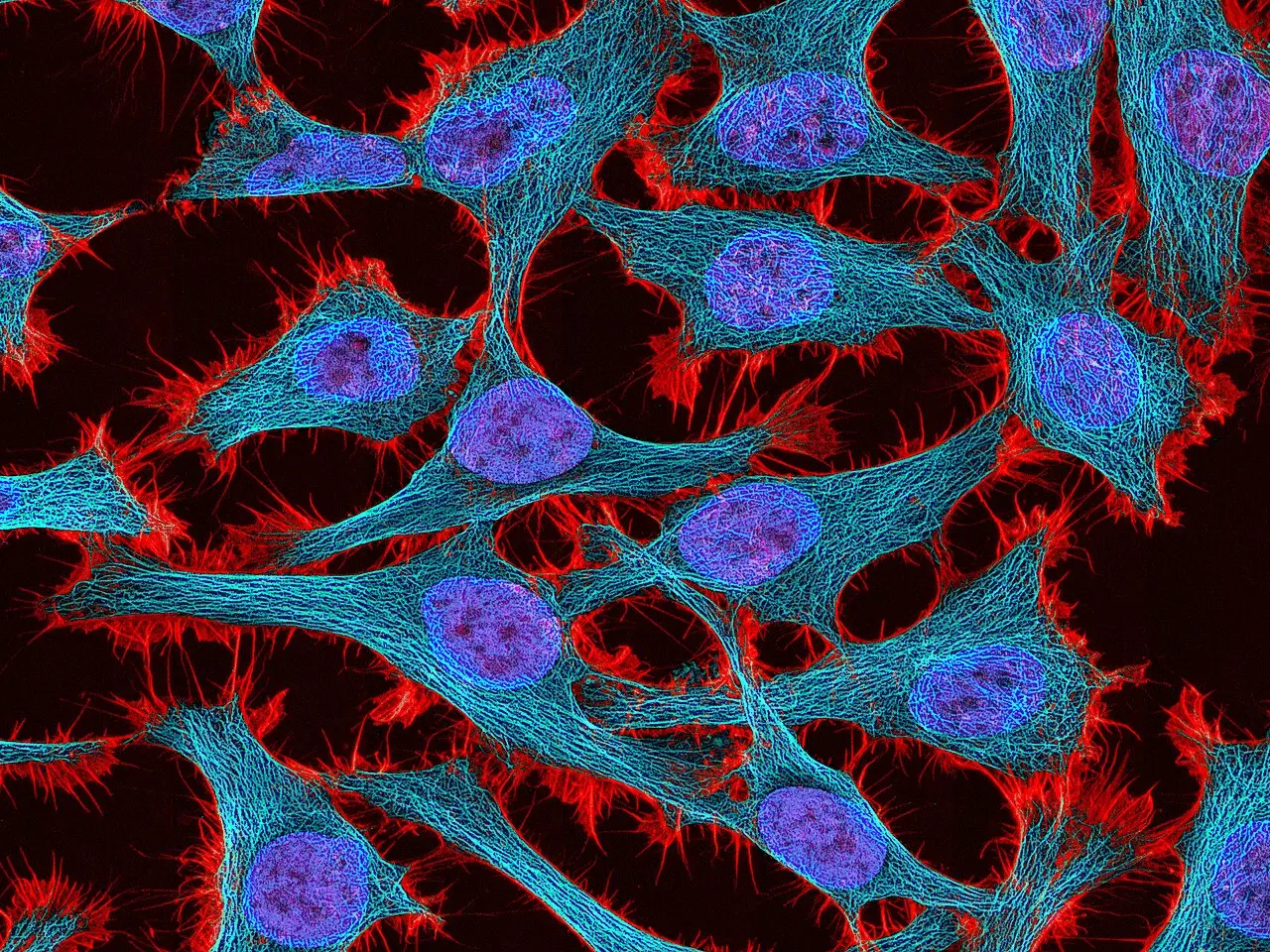
Red marks actin, cyan marks microtubules, and blue marks nuclei. These colors are experimental labels—not the natural colors of genes or cells.
NIH · Public domain ↗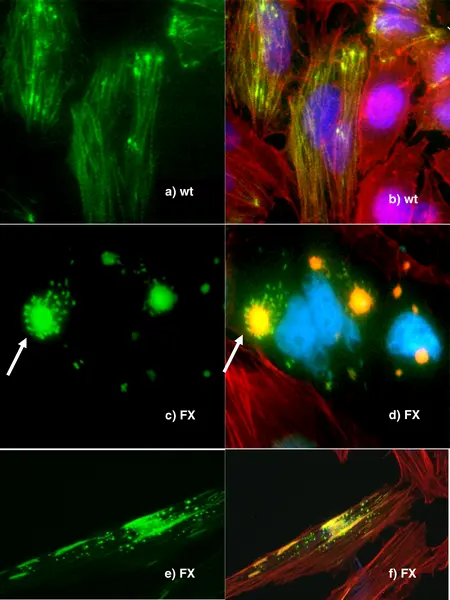
Wild-type and P239S palladin constructs were compared in HeLa cells during research into a reported familial pancreatic-cancer variant. This is not a diagnostic image.
CC BY 1.0 · Rights ↗Genes carry instructions for making proteins. Changes to those instructions can affect the systems that control growth, repair, and cell survival.
01 / CELL INSTRUCTIONS
Some changes encourage cells to grow. Others remove the signals that normally slow growth, repair DNA, or remove damaged cells. Cancer usually develops through a combination of changes rather than one universal error.
Even cancers that begin in the same organ may carry different combinations of molecular changes. That is one reason a site of origin is only the first part of classification.
02 / TWO DIFFERENT QUESTIONS
These arise during a person’s lifetime and are present in the tumor. They are not automatically passed to children.
These can raise cancer risk in a family, but increased risk does not mean cancer is certain.
Testing a tumor to guide treatment is different from testing healthy cells for an inherited cancer-risk variant. A clinician or genetic counselor can explain which question a test is designed to answer.
03 / BIOMARKER TESTING
Biomarker testing looks for genes, proteins, or other substances that provide information about a cancer. Depending on the cancer and test, a result may help classify the disease, estimate how it could behave, or identify a treatment that may be more or less likely to help.
Tests may look for specific variants, larger panels of genes, or patterns such as genomic instability.
Some proteins can be detected with laboratory methods and may help classify a tumor or reveal a treatment target.
Some tests evaluate broader features of a tumor rather than a single gene or protein.
A tissue sample is often used for tumor biomarker testing. In some situations, material released by cancer cells can be tested from blood. Not every person needs every test, and testing availability varies.
04 / WHAT A RESULT MEANS
A biomarker may suggest that a treatment is worth considering, but it cannot promise a response. Other features—including cancer type, stage, prior treatment, overall health, and the strength of available evidence—remain important.
Likewise, an inherited risk variant changes probability, not certainty. Results can affect relatives as well as the person tested, which is why professional genetic counseling can be important.
SOURCES / LEARN MORE
General education only. A qualified clinical team must interpret whether testing is appropriate and what a result means.